Playground · research instrument
DSP · AudioRT60 Calculator — Sabine & Eyring
Enter your room dimensions and average absorption coefficient. Get Sabine and Eyring reverberation time side by side, plus the Schroeder frequency that tells you which half of the spectrum the number actually applies to.
Independent research instrument — not claimed as MakerPortal shipped product code. Methods, equations, assumptions, and limitations are disclosed so you can inspect what the page does and does not establish.
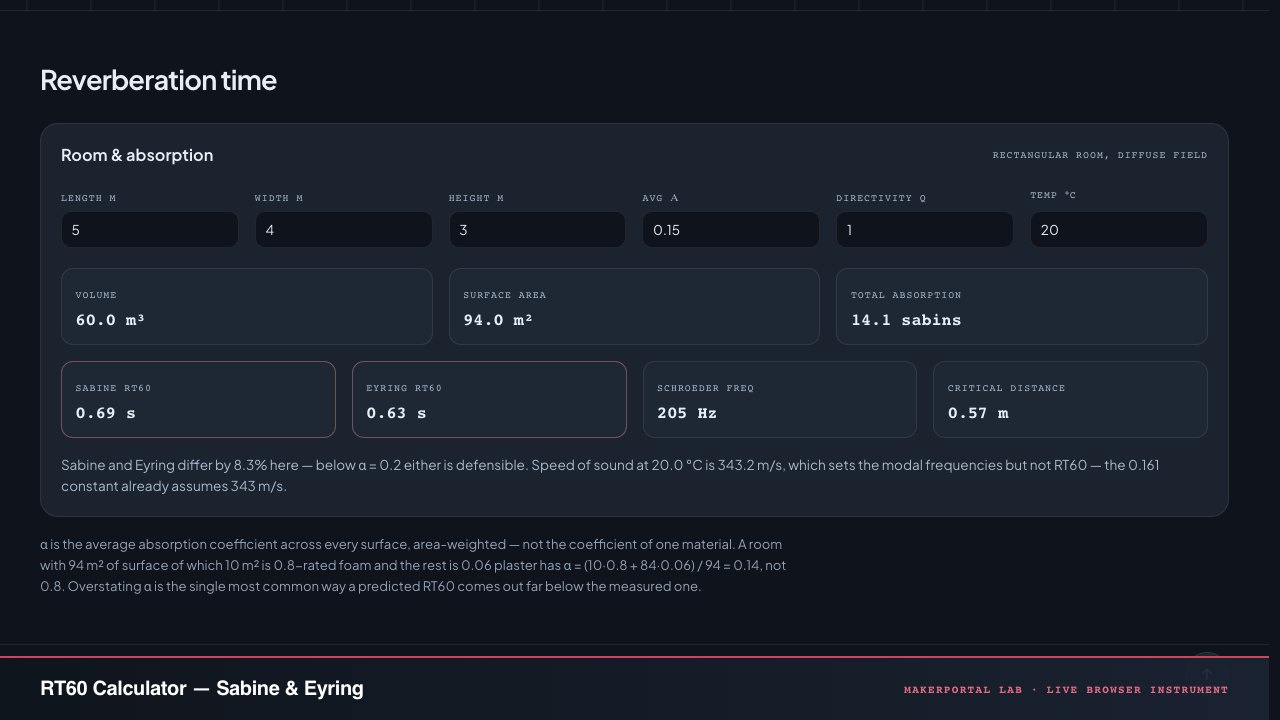
Reverberation time
Room & absorption
rectangular room, diffuse field60.0 m³
94.0 m²
14.1 sabins
0.69 s
0.63 s
205 Hz
0.57 m
α is the average absorption coefficient across every surface, area-weighted — not the coefficient of one material. A room with 94 m² of surface of which 10 m² is 0.8-rated foam and the rest is 0.06 plaster has α = (10·0.8 + 84·0.06) / 94 = 0.14, not 0.8. Overstating α is the single most common way a predicted RT60 comes out far below the measured one.
Sabine, Eyring, and where they part company
Sabine (1900)
Wallace Sabine derived this empirically at Harvard, moving seat cushions into a lecture hall until he had a curve. A is total absorption in metric sabins — the sum of every surface area times its coefficient.
Note what happens as α approaches 1: A approaches S, and T₀ approaches 0.161V/S — a finite, non-zero number. Sabine says a perfectly absorptive room still reverberates. It does not. That is the formula's known failure, and it is why Eyring exists.
Eyring (1930)
Eyring counted reflections properly. Each one multiplies the remaining energy by (1 − α), so the decay is governed by the logarithm of that survival factor rather than by α itself.
As α approaches 1, ln(1 − α) diverges to negative infinity and T₀ collapses to zero — the anechoic limit, correctly. For small α, −ln(1 − α) ≈ α and Eyring reduces to Sabine, which is why the two agree in ordinary rooms.
| Average α | Sabine | Eyring | Disagreement |
|---|
Computed live for the room dimensions you entered above, by the same two functions the calculator uses.
What to aim for
Mid-band targets (500 Hz – 1 kHz) for a furnished room in use. Bass will always be longer; a low-frequency RT60 of roughly 1.2 to 1.5 times the mid-band figure is normal and generally accepted.
| Room | Target RT60 | Why |
|---|---|---|
| Recording control room | 0.20 – 0.30 s | Short enough that the room does not colour a monitoring decision. |
| Home studio / voiceover | 0.25 – 0.40 s | Dry, but not so dead that talking in it feels wrong. |
| Live tracking room | 0.40 – 0.70 s | Deliberate room sound — you are recording the space on purpose. |
| Classroom / meeting room | 0.40 – 0.60 s | Speech intelligibility. Above ~0.8 s consonants smear into each other. |
| Cinema / home theatre | 0.30 – 0.50 s | Dialogue clarity plus a stable surround image. |
| Concert hall (symphonic) | 1.80 – 2.20 s | Envelopment and blend. The one case where long is the goal. |
Predicting it is not measuring it
1. Excite the room
A balloon pop or starter pistol gives you an impulse directly. A swept sine through a monitor, deconvolved, gives a far better signal-to-noise ratio and is what any modern measurement package does. You need at least 45 dB of headroom above the room's noise floor to see a 60 dB decay at all.
2. Fit the decay, don't chase 60 dB
Almost nobody measures a true 60 dB decay — the noise floor arrives first. The standard practice is to fit a line over the 5 to 25 dB region (T20) or 5 to 35 dB (T30) and extrapolate. ISO 3382 defines both. If T20 and T30 disagree by more than about 10 percent, the decay is not a single straight line and the room has two coupled spaces or a strong flutter.
3. Average positions
One microphone position measures one point in a standing-wave field, not the room. Take at least three source positions and three to six microphone positions and average the decay curves. The spread between them is itself information: a wide spread means the field is not diffuse and the formulas above were never going to apply.
Measuring it for real
A calibrated omnidirectional measurement microphone and an interface with clean gain are the whole shopping list. Everything else is software.
 Microphone
BEHRINGER ECM8000
Reference omni for acoustic measurement — captures the same pressure field these fast calculators approximate with ray-tracing and modal sums.
 $229.00Audio interface
Behringer UMC1820 Audiophile 18x20 USB Audio/MIDI Interface with Midas Mic Preamplifiers and ADAT I/O | For Recording Microphones and Instruments
Audio interface used building Biquadia — 8-preamp USB I/O for real-time DSP testing.
 $59.98Microphone
Dayton Audio EMM-6 Precision Omnidirectional Electret Condenser Microphone for Room Acoustic Analyzers and Audio Measurement Systems, Calibration Data File with Response Graph Included
Omni condenser with cal file — pair with REW to measure SPL, RT60, and comb filtering the acoustic calculator suite computes via image-source method.
 $39.98Tool
Focusound 24 Packs Acoustic Foam Panels Pyramid 2" X 12" X 12", Soundproofing Foam Noise Cancelling Foam with 120 PCS Double-Side adhesive
Pyramid foam taming room modes at f = n c / 2L — measure RT60 drop and compare to acoustic-calculator predictions for absorption coefficient vs frequency.
 $38.38Book
Master Handbook of Acoustics, Seventh Edition
Bible of RT60, Sabine, and absorption coefficients — the exact formulas these acoustic calculators implement for reverb, room modes, and critical distance.
 $149.95Microphone
miniDSP UMIK-1 Calibrated Measurement Microphone
Calibrated USB mic with individual cal file — measure your room's RT60 and modal peaks to validate the room-mode eigenfrequencies this calculator predicts.
Prices shown were retrieved from the Amazon Product Advertising API on 8 October 2026 and are indicative only — the price and availability on Amazon at the time of purchase apply.
Related calculators
Room Mode Calculator
Below the Schroeder frequency this page prints, RT60 stops meaning anything. That is the region modes own.
Helmholtz Resonator Calculator
Tuned absorption for a single problem frequency, where broadband material would need to be metres thick.
Acoustics Calculators
The full bench — speed of sound, wavelength, delay, SPL summation, Doppler, mass law and NR curves.
Hardware Rigs & Field Notes
Hardware build / Mic arrays
Real-Time Acoustic Beamforming on an iPhone with miniDSP UMA-8
Live SRP-PHAT direction finding, superdirective MVDR beamforming on a 44 mm ring, and physical directivity limits.
Hardware build / Measurement
Headphone Measurement with a Binaural Head: HD 650 + UMC1820
HATS measurement rig, true-RMS multimeter calibration under load, and per-ear swept-sine transfer functions.
Frequently asked questions
What is RT60?
RT60 is the time it takes for sound in a room to decay by 60 decibels after the source stops — a drop to one millionth of the original sound intensity. It is the single most-cited number in room acoustics because it captures, in one figure, how long the room keeps talking after you stop. It is frequency dependent: nearly every real room has a longer RT60 at 125 Hz than at 2 kHz, so a single quoted value is conventionally the mid-band average around 500 Hz to 1 kHz.
Should I use the Sabine or the Eyring formula?
Below an average absorption coefficient of about 0.2 — which covers most furnished rooms — they agree closely and either is fine. Above roughly 0.3, use Eyring: Sabine systematically overestimates because it assumes sound loses only a fraction of its energy per reflection, which stops being true once surfaces are genuinely absorptive. The clearest way to see the difference is to set ᾱ to 0.99 in the calculator above. Eyring collapses towards zero, which is what an anechoic chamber actually does. Sabine still reports a substantial reverberation time for a room that has essentially none.
Why does my measured RT60 not match the calculated value?
Because both formulas assume a diffuse field — sound energy uniformly distributed and arriving from all directions equally. Real rooms violate that in three common ways: absorption concentrated on one surface (a carpeted floor with bare walls), a room shape far from cubic, and non-uniform coupling to adjacent spaces. Rectangular rooms with absorption spread over several surfaces typically land within 10 to 20 percent. A room with all its absorption on one plane can be off by a factor of two, and no statistical formula will fix that — measure it.
What is the Schroeder frequency and why does the calculator show it?
The Schroeder frequency divides your room into two acoustic regimes, and it is derived from RT60 and volume, so this calculator already has everything it needs. Below it, room modes are sparse and separately audible as discrete booms and nulls — that is where you need modal treatment such as bass traps and placement changes. Above it, modes overlap densely enough to behave statistically, and that is the region where RT60 is a meaningful number at all and where broadband absorption works. Applying an RT60 target below the Schroeder frequency is applying a statistic to a region that is not statistical.
What is critical distance?
Critical distance is where the direct sound from a source and the reverberant field of the room are equally loud. Closer than that, you mostly hear the source; further away, you mostly hear the room. It is why near-field monitoring works and why a microphone placed across a live room sounds washed out. It depends on the directivity factor Q of the source as well as the room, which is why the calculator takes Q as an input — a horn-loaded source with Q of 5 pushes its critical distance more than twice as far as an omnidirectional one in the same room.
Does the calculator work in feet?
The inputs are metric — metres and cubic metres — because the 0.161 constant in both formulas is metric. To convert, multiply feet by 0.3048. A 16 by 13 by 10 foot room is 4.88 by 3.96 by 3.05 metres. If you prefer to work in imperial throughout, the equivalent Sabine constant is 0.049 with volume in cubic feet and absorption in square-foot sabins.
Shareable still
The instrument, captured—not illustrated.
This 16:9 frame is rendered from the real browser instrument above. It is the page's canonical preview for image search, link unfurls, and posts that need to show what the tool actually does.
Download 1280 × 720 JPEG