Playground · research instrument
DSP · AudioHelmholtz Resonator Calculator
Cavity volume, neck diameter, neck length — get the resonant frequency, with the end corrections for both ends of the neck, which most calculators leave out and which move the answer by about fifteen percent.
Independent research instrument — not claimed as MakerPortal shipped product code. Methods, equations, assumptions, and limitations are disclosed so you can inspect what the page does and does not establish.
Resonant frequency
Cavity & neck
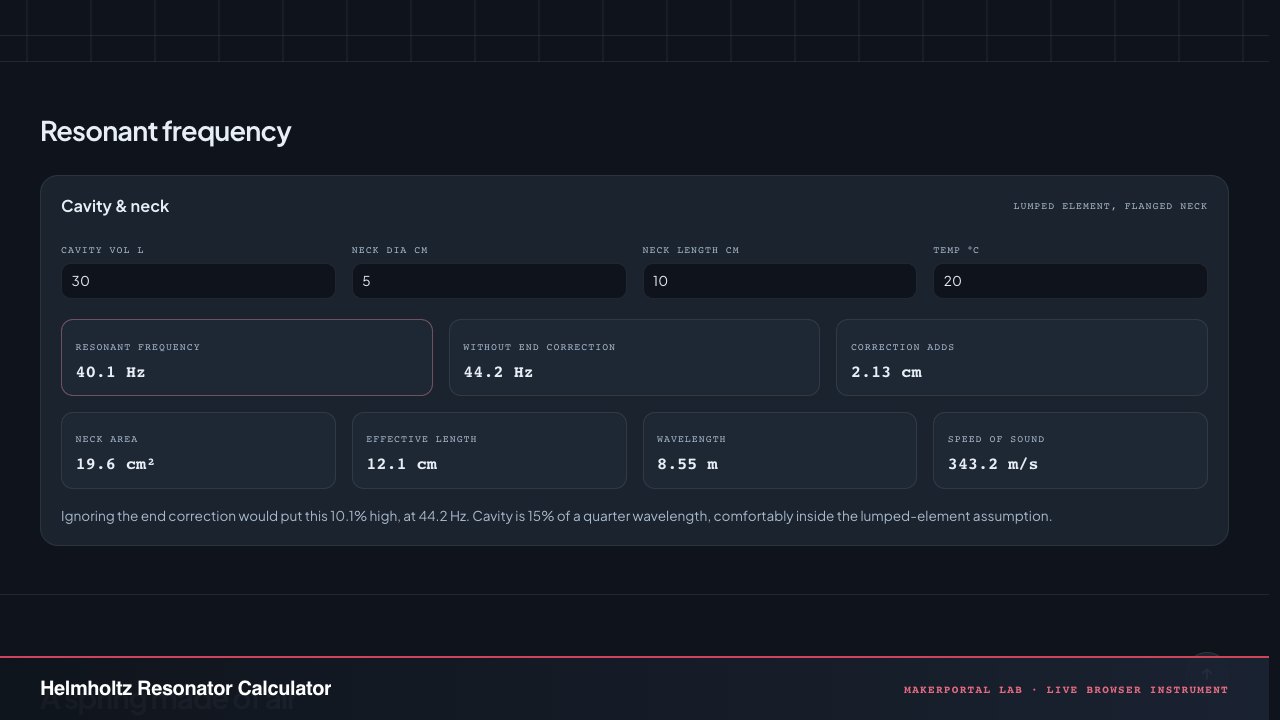
lumped element, both neck ends corrected37.8 Hz
44.2 Hz
3.66 cm
19.6 cm²
13.7 cm
9.08 m
343.2 m/s
A spring made of air
The plug of air in the neck has mass. The air sealed in the cavity resists being compressed, so it has stiffness. Push the plug inward and the cavity pushes back; let go and it overshoots. That is a mass on a spring, and it has exactly one natural frequency.
S is the neck cross-sectional area, Vthe cavity volume, Leff the effective neck length andc the speed of sound. Everything scales as a square root, which is why tuning an octave lower needs four times the cavity volume — and why practical bass traps get large fast.
The correction that decides the answer
Air outside the neck is dragged along with the plug inside it, so the moving mass exceeds what the physical neck contains, and each end adds its own length: 0.85 neck radii for an end flush with a wall (Rayleigh's flanged opening, 8/3π rounded) and 0.6133 for a bare tube end (Levine and Schwinger's unflanged pipe):
A tube through a panel, a speaker port or a bottle has one end of each kind: 1.4633 radii in all, the 0.732·D of loudspeaker port formulas. A hole straight through a wall has two flush ends, 1.7 radii. The inner end's correction shrinks when the neck is wide against the cavity (Ingard), and grows when it sits close to a wall.
For a short, wide neck the correction can exceed the neck itself. This is the dominant error in every hand-rolled Helmholtz calculation, and it always errs the same way: omit it and the predicted frequency is too high, so the resonator you build tunes lower than the number you designed to. Both figures are printed above so you can see the size of the gap for your geometry rather than take it on trust.
Where the number gets used
Bass trap for one problem mode
A room with a 42 Hz axial mode that will not go away needs either two metres of porous absorber or a resonator tuned to 42 Hz. The resonator wins on depth every time below roughly 100 Hz — that is the entire reason the device is still used.
Bass-reflex loudspeaker port
A ported speaker box IS a Helmholtz resonator: the cabinet is the cavity, the port is the neck. The tuning frequency quoted on any vented alignment is this calculation. To solve for the length that hits a target tuning instead, use the port length calculator.
Engine and duct silencers
A side-branch resonator on an intake or exhaust runner presents near-zero impedance at its tuned frequency and shorts that component to ground, acoustically. Motorcycle airbox resonators and HVAC duct silencers are the same device at different scales.
Perforated-panel absorbers
A perforated board over an air gap is an array of Helmholtz resonators sharing one cavity. Treat the open area per hole as S and the board thickness as L, set both neck ends flush, and this formula gives the absorption peak of the whole panel.
Where this model stops being true
Cavity near a quarter wavelength
The lumped model needs uniform pressure in the cavity. Once any cavity dimension approaches a quarter of the wavelength, the box has its own standing waves and the single-resonance prediction breaks down. The calculator prints the wavelength so you can check that ratio yourself.
Very short necks
When the physical neck is shorter than its own radius, the end correction dominates and the geometry is really an orifice in a plate rather than a neck. Choose the neck ends to match: a hole in a plate is flush on both sides (0.85 per end), and a bare pipe is free at both ends (0.6133 per end), so it tunes higher than a flanged one.
High amplitude
At high levels the air in the neck separates from the wall and jets, which adds nonlinear loss and detunes the resonator downward. Loudspeaker ports show this as compression and chuffing near maximum excursion, which is why vented designs flare their port ends.
Verifying the tuning you built
A resonator is easy to measure: sweep it and look for the absorption notch. A measurement microphone and an interface with clean gain are enough to see whether you hit the frequency you designed for.
 Microphone
BEHRINGER ECM8000
Reference omni for acoustic measurement — captures the same pressure field these fast calculators approximate with ray-tracing and modal sums.
 $229.00Audio interface
Behringer UMC1820 Audiophile 18x20 USB Audio/MIDI Interface with Midas Mic Preamplifiers and ADAT I/O | For Recording Microphones and Instruments
Audio interface used building Biquadia — 8-preamp USB I/O for real-time DSP testing.
 $38.38Book
Master Handbook of Acoustics, Seventh Edition
Bible of RT60, Sabine, and absorption coefficients — the exact formulas these acoustic calculators implement for reverb, room modes, and critical distance.
 $149.95Microphone
miniDSP UMIK-1 Calibrated Measurement Microphone
Calibrated USB mic with individual cal file — measure your room's RT60 and modal peaks to validate the room-mode eigenfrequencies this calculator predicts.
Prices shown were retrieved from the Amazon Product Advertising API on 8 October 2026 and are indicative only — the price and availability on Amazon at the time of purchase apply.
Related calculators
Speaker Port Length Calculator
The same physics inverted: fix the tuning you want and solve for the neck length that delivers it.
Room Mode Calculator
Find the mode you are trying to kill before you build a resonator to kill it.
RT60 Calculator
Sabine and Eyring reverberation time, plus the Schroeder frequency that separates modal from statistical.
Frequently asked questions
What is a Helmholtz resonator?
A Helmholtz resonator is a cavity of trapped air connected to the outside through a narrow neck. The air in the neck moves as a lump of mass and the air in the cavity acts as a spring, so the device is a mechanical mass-spring oscillator built entirely out of air. Blowing across the top of a bottle is the everyday demonstration: the bottle is the cavity, the mouth is the neck, and the note you get is the resonant frequency this calculator predicts.
What is the end correction and why does it matter so much?
The air that moves does not stop neatly at the ends of the neck. A slug of air just outside each opening is dragged along too, so the neck behaves acoustically longer than it measures physically. Each end adds its own length: 0.85 times the neck radius for an end flush with a wall (a flanged end) and 0.6133 times the radius for a bare tube end. Pick the neck's two ends in the calculator. It is not a rounding detail: for a 5 cm diameter neck that is 10 cm long, with one end flush and one free, the corrections add 3.7 cm, 37 percent of the neck, and lower the predicted frequency by about 17 percent. A calculator that omits them predicts a frequency that is too high, and a neck cut to its numbers tunes low.
Why does the formula not include the cavity shape?
Because the model assumes the cavity is acoustically small — every dimension much shorter than a wavelength at the resonant frequency — so the pressure inside it is uniform and only the volume matters. The default here, a 30 litre cavity resonating near 40 Hz, has a wavelength of 8.6 metres against a box roughly 0.31 metres across: about 15 percent of a quarter wavelength, so the assumption holds comfortably. It stops holding as the cavity approaches a quarter wavelength, at which point the box has standing waves of its own and you need a full modal treatment rather than a lumped-element one. The calculator prints that ratio for your geometry.
How sharp is the resonance?
Sharper than most people want. An untreated resonator has a high Q, meaning it absorbs strongly over a narrow band and does nothing an octave away. That is the point when you are killing one mode, and a liability when you wanted broadband control. Adding a light layer of fabric or open-cell foam across the neck introduces resistance, lowers Q, and trades peak absorption for bandwidth. Most practical bass traps are deliberately damped this way.
Does temperature change the tuning?
Yes, through the speed of sound, and the calculator exposes temperature for that reason. Frequency scales directly with c, which rises about 0.17 percent per degree Celsius near room temperature. A resonator tuned to 42 Hz at 20 °C sits near 42.7 Hz at 30 °C. That is inaudible in a room but it matters in an engine intake, where air temperatures swing by 60 degrees or more and the tuning moves by several percent.
Shareable still
The instrument, captured—not illustrated.
This 16:9 frame is rendered from the real browser instrument above. It is the page's canonical preview for image search, link unfurls, and posts that need to show what the tool actually does.
Download 1280 × 720 JPEG