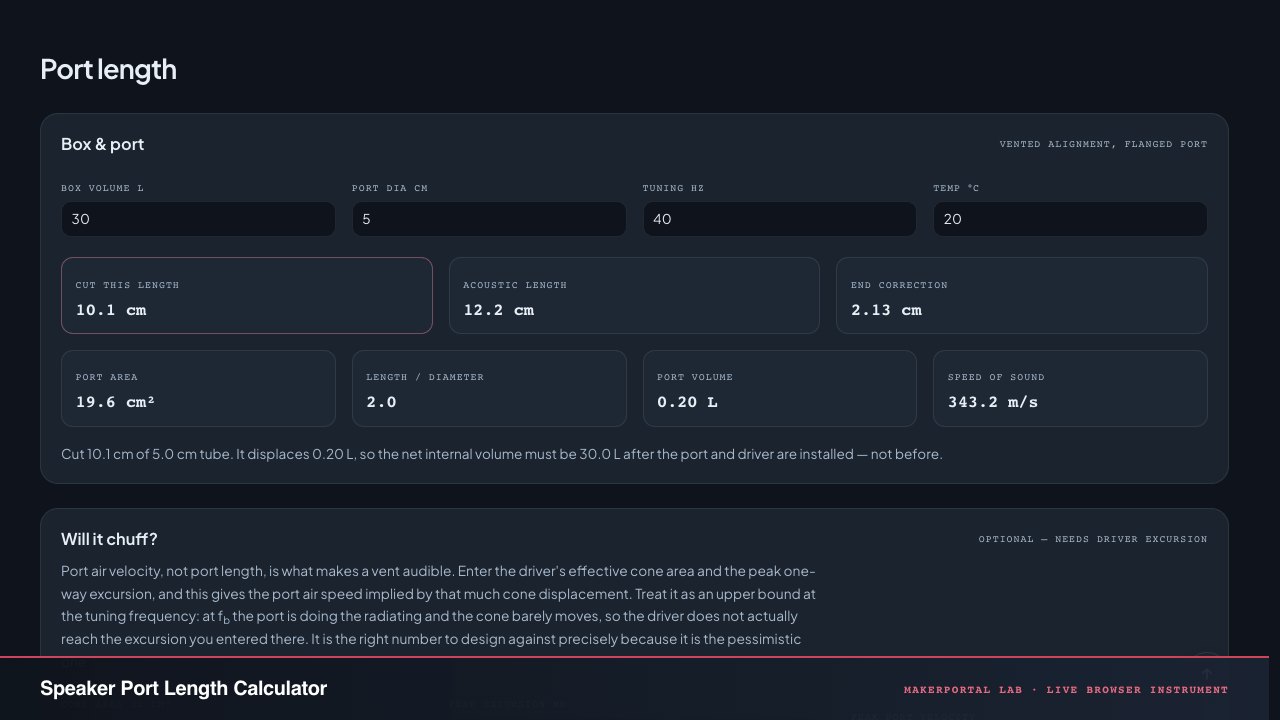
How do I calculate port length for a subwoofer box?⌄
You need the net internal box volume, the port diameter and the tuning frequency. The port must present an acoustic length S / (k²V) with k = 2πf/c, and the cut length is that minus the end corrections of both ends: 1.4633 × the port radius (0.85 for the end flush with the baffle plus 0.6133 for the free end inside the box, the 0.732 × diameter of most port formulas). For a 32 Hz tuning in a 50 L box with a 10 cm port, the acoustic length is 45.8 cm, the end correction is 7.32 cm, and the port to cut is 38.5 cm (both worked examples above are solved by the same function this calculator runs). Enter the box volume with the driver, bracing and port already subtracted.
How do I pick a speaker port size (diameter)?⌄
Pick the diameter by port air speed, then check the length fits. The calculator prints the peak port air speed implied by a driver cone area and peak excursion: 7.51 m/s (2.2% of the speed of sound) for a 220 cm² cone moving 6 mm into a 7.5 cm port at 40 Hz, and 16 m/s for a 520 cm² cone moving 12 mm into a 10 cm port at 32 Hz. A narrow port is short but fast; once the flow separates from the wall you hear chuffing and the bass compresses at high level. A wide port keeps the air speed down but the required length scales with port area, so it gets long fast: the 38.5 cm port in the first example is 3.8 times its own diameter. Take the largest diameter whose length still fits the cabinet, or use two smaller ports.
What does this speaker port tuning calculator actually compute?⌄
It solves the vented-box resonance for the length of a straight, round port of constant diameter: Helmholtz resonance with the cabinet as the cavity and the port as the neck, using an end correction for each end of the port: 0.85 times the port radius for the outer end, flush with the baffle, and 0.6133 times the radius for the inner end, open inside the box (1.4633 r in all, the 0.732 × diameter of most port formulas), and the speed of sound at the air temperature you enter. Run the other way, the tuning frequency of a built port is f = (c / 2π) √(S / (V L)), where L is the cut length plus the end correction; the unit tests check each worked example by that formula. It does not model a port flare, port wall thickness, a driver or bracing displacing the box volume, stuffing, or the response of the box. The tuning frequency itself comes from the driver and the alignment you choose, not from here.
Can I use this as a square or slot port calculator?⌄
Approximately. The calculator takes a round diameter and uses only the cross-section area, with the end correction taken from the radius of the round port of equal area, √(S/π). For a rectangular port, enter the diameter of the round port with the same area: 2√(width × height / π). A 5 cm × 5 cm square port has the area of a 5.642 cm round port, so enter 5.64. That equal-area substitution is an approximation: the real end correction depends on the outline, and it is less reliable for a tall narrow slot than for a square. Cut the port long, measure the impedance minimum, and trim.
Is there a flared port, aero port or PSP calculator here?⌄
No. This page computes the length of a straight port of constant diameter and has no flare input. Flared ports (sold under names such as aero or precision ports) widen toward one or both ends mainly to lower the air speed at the port opening, which reduces turbulence and chuffing; this page does not compute how a given flare changes the tuning or the length. For a flared port, the straight-port length from this calculator is a first estimate only: use the maker’s stated length for that specific port if one is given, or cut long, measure the impedance minimum between the two peaks, and trim. The port air speed figure on this page is for the straight port you entered.
Why is my port length coming out negative?⌄
Because the port is too narrow to reach that tuning at all. The required acoustic length scales with port area, but the end correction — the air dragged along outside each opening — scales only with port radius. Shrink the port and the correction shrinks more slowly than the requirement, until the free length from the two ends alone overshoots the target before you have added any physical tube. It is a real answer, not a failure. The fix is to go wider: increase the port diameter, and the calculator prints the minimum diameter that works for your box and tuning. Reducing the box volume or tuning lower also helps, since the minimum diameter scales with box volume and with the square of the tuning frequency.
Can I use two ports instead of one?⌄
Yes, and it is often the right answer when a single port of adequate area would be too long to fit. Two ports of the same diameter have twice the area, so each one needs about the same acoustic length as a single port of the doubled area — meaning each of two ports is longer than one port of the same diameter, not shorter. Enter the combined area as the equivalent single diameter: for two 5 cm ports, that is 5 × √2 ≈ 7.07 cm. The calculator’s end correction then uses that larger radius, so add 1.5 cm to the result for each real port (1.4633 × the difference in radius).
How accurate is this in a real cabinet?⌄
Close enough to build from, not close enough to skip measuring. The formula assumes a rigid box of the volume you entered, and real cabinets are not rigid, the driver and bracing displace some volume, and stuffing changes the effective compliance of the air. Expect the built tuning to land a few percent below the prediction. That is why the standard practice is to build the port long, measure the impedance minimum between the two peaks, and trim.