Field note / Edge Hardware Systems
Running 3B LLMs on Edge SBCs & MCUs
Why parameter count isn't the bottleneck for on-device LLMs: memory bandwidth, GGUF/INT4 quantization math, and ANE lessons from Thumbdash and itria.

Joshua HriskoPrincipal Engineer
6 min readSan Francisco, CA
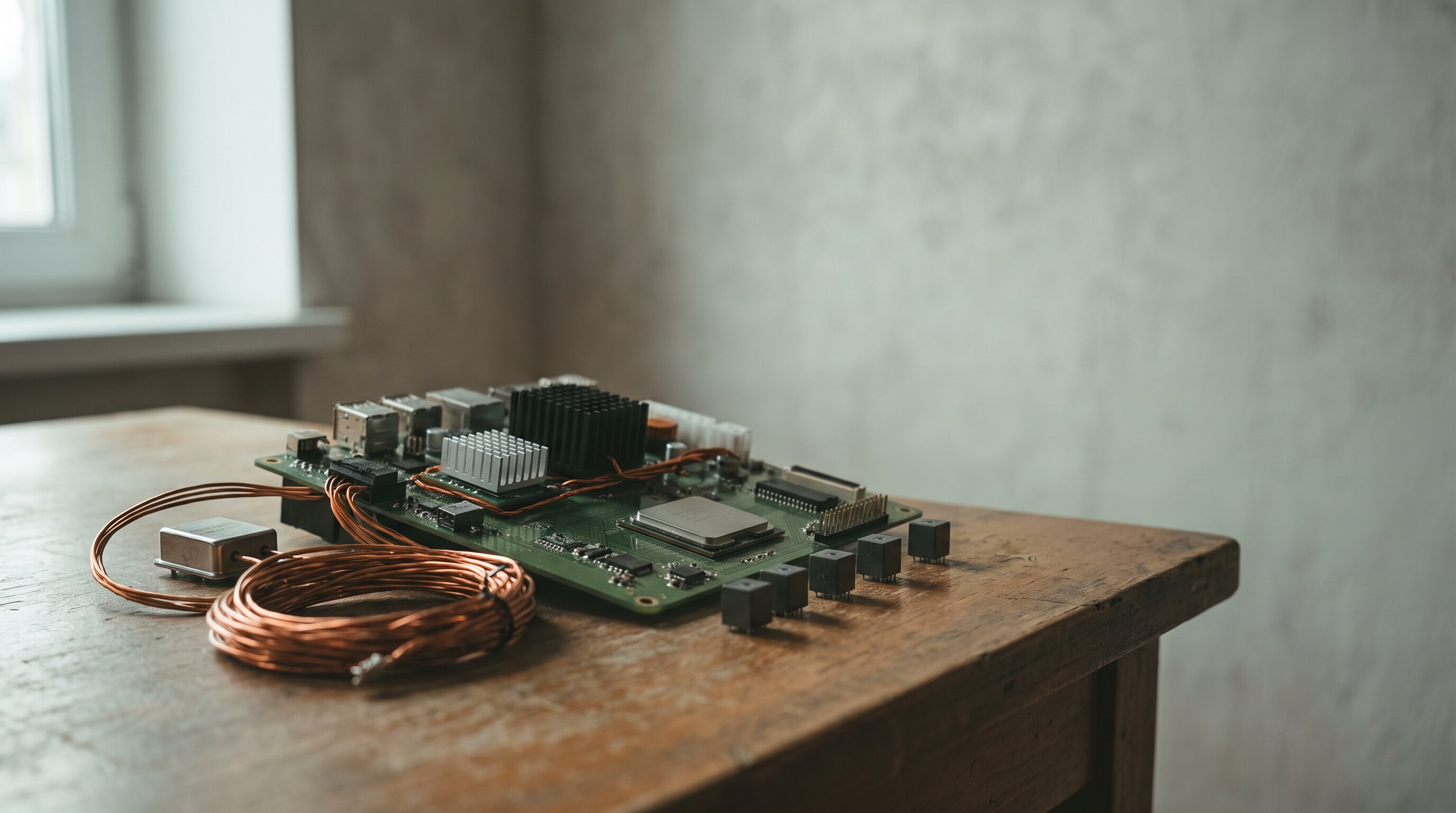
When developers try running local LLMs on low-power devices (Raspberry Pi 5, Jetson Orin Nano, or Apple Silicon), they almost always blame FLOPs or CPU core counts when generation crawls to a halt.
In practice, autoregressive LLM inference during the token generation phase is strictly memory bandwidth bound. Understanding the arithmetic behind weight bandwidth and KV-cache scaling is the difference between a sluggish 1.2 tok/sec experience and a snappy 25+ tok/sec local app.
1. The Autoregressive Memory Bottleneck
During matrix-vector multiplication in token generation, every single weight parameter must be fetched from main RAM (or Unified Memory) into L1/L2 cache once per output token.
The theoretical token generation speed is bounded by:
Measured SBC Bandwidth Baseline
| Hardware Target | Memory Type | Rated Bandwidth | 3B Q4 Model (1.8 GB) | 7B Q4 Model (4.2 GB) |
|---|---|---|---|---|
| Apple M4 Max | LPDDR5X (Unified) | 400 GB/s | ~220 tok/sec | ~95 tok/sec |
| NVIDIA RTX 4090 | GDDR6X (Dedicated) | 1,008 GB/s | ~560 tok/sec | ~240 tok/sec |
| NVIDIA Jetson Orin Nano | LPDDR5 128-bit | 68 GB/s | ~37 tok/sec | ~16 tok/sec |
| Raspberry Pi 5 (8GB) | LPDDR4X 32-bit | 17 GB/s | ~9.4 tok/sec | ~4.0 tok/sec |
2. Quantization Tradeoffs: Q4_K_M vs Q8_0 vs FP16
Quantization reduces memory footprint, which directly increases token generation speed by reducing total bytes transferred across the bus.
- FP16 (2.0 B/param): 3B Model = 6.0 GB VRAM (Requires 16GB+ RAM Board)
- Q8_0 (1.06 B/param): 3B Model = 3.2 GB VRAM (Fits 4GB Board)
- Q4_K_M (0.56 B/param): 3B Model = 1.7 GB VRAM (Fits 2GB Board — Recommended)
In our testing on Thumbdash (which embeds SmolLM2-360M-Instruct via llama.cpp + Metal on iOS), quantization down to Q4_K_M delivered a 3.5x speedup with negligible loss in Levenshtein text scoring compared to full FP16.
3. Recommended Studio Hardware Picks
When configuring local edge AI test benches in the studio, we rely on verified hardware:
- NVIDIA Jetson Orin Nano Developer Kit — 68 GB/s LPDDR5 memory bus with 1024 CUDA cores.
- SanDisk 1TB Extreme Portable SSD — 2000 MB/s USB-C transfer speeds for loading large GGUF model weights.
- Hands-On Machine Learning with Scikit-Learn, Keras, and TensorFlow — Essential reference for quantization and neural net optimization.
Try out our interactive LLM VRAM & KV-Cache Footprint Calculator to test custom model configurations and hardware targets live in your browser.
4. Final Thoughts
Building on edge hardware forces a deep understanding of memory architectures that cloud developers rarely encounter. It’s a space where optimization directly translates to viability—and where every byte saved is a token earned. As newer quantizations arrive (like FP8 and INT4), the barrier to running powerful local AI will continue to lower, putting previously unimaginable capabilities into the palms of our hands.
FAQ
Why is memory bandwidth more important than TFLOPS for local LLMs?
During autoregressive token generation, every weight parameter must be loaded from memory to cache once per output token. If your memory bandwidth is 68 GB/s, reading a 3.4 GB model weights file caps generation at 20 tokens/sec, regardless of whether your NPU has 10 TFLOPS or 100 TFLOPS.
What is the best single-board computer for running local 3B/7B LLMs?
For ARM CUDA workloads, the NVIDIA Jetson Orin Nano Super (68 GB/s LPDDR5) is the top choice. For x86 compatibility, the DFRobot LattePanda 3 Delta provides full desktop OS support. For Apple Silicon, any M-series Mac with Unified Memory provides up to 400 GB/s bandwidth.
Recommended Studio & Hardware Gear
Affiliate links support independent R&DTested studio equipment and reference hardware utilized for this build. Product images & pricing sourced from Amazon Creators API / SparkFun Electronics.
 $249SBC
NVIDIA Jetson Orin Nano Super Developer Kit
Jetson Orin Nano Super via SparkFun — edge PINN / SLAM compute. Third-party NVIDIA kit (tracked referral).
 $49.50Book
Hands-On Machine Learning with Scikit-Learn, Keras, and TensorFlow: Concepts, Tools, and Techniques to Build Intelligent Systems
Practical ML reference used while building itria.
 $40.00Book
Designing Machine Learning Systems: An Iterative Process for Production-Ready Applications
ML systems-design reference used while building itria.
Prices shown were retrieved from the Amazon Product Advertising API on 19 July 2026 and are indicative only — the price and availability on Amazon at the time of purchase apply.