Clustered, normalized vectors
A seeded generator creates normalized Float32 vectors around random centroids. Metadata buckets provide a visible filter-selectivity control. The bytes readout counts vector storage only.
Playground · research instrument
On-device AIGenerate a deterministic clustered corpus in this browser. Exact cosine search establishes ground truth; a disclosed IVF-style coarse index skips candidates. Sweep probe count and measure the recall you keep, the work you avoid, and the latency your device actually sees.
Independent research instrument — not claimed as MakerPortal shipped product code. Methods, equations, assumptions, and limitations are disclosed so you can inspect what the page does and does not establish.
Simulator · Local measurements only
Every row below is computed after you press run. Changing any control clears the measurements; the chart never carries estimates forward.
The seed makes corpus values repeatable, not timings. Browser scheduling, CPU state, JIT warm-up, and power mode still affect milliseconds.
Bars: approximate latency · dashed: exact baseline · line: recall@k
| Probes | Candidates | Exact ms/q | Approx ms/q | Recall@k | Measured ratio |
|---|---|---|---|---|---|
| Run a sweep to populate measured rows. | |||||
Anatomy · What this establishes
A seeded generator creates normalized Float32 vectors around random centroids. Metadata buckets provide a visible filter-selectivity control. The bytes readout counts vector storage only.
Exact cosine scans every vector allowed by the metadata predicate, maintains the top-k IDs, and becomes the recall reference. It is timed after one unreported warm-up query.
The teaching index scores cluster centroids, opens the requested number of buckets, and evaluates only those candidates. It resembles an IVF coarse quantizer but makes no claim about a provider's internal index.
Recall, candidate count, and per-query latency are averaged across eight deterministic queries. A speed ratio appears only from the two measured clocks; a slower shortcut stays slower on screen.
Gear · Third section
 $4,299.00Computer
Recommended studio reference hardware for heavy on-device ML and local LLM inference.
 $2,299.00Computer
18-core CPU, 32-core GPU, 36GB unified memory, 512GB storage, 10Gb Ethernet — the entry point into the same on-device ML and local-LLM workflow as the M4 Max box.
 $40.00Book
ML systems-design reference used while building itria.
 $49.50Book
Practical ML reference used while building itria.
 Accelerator
USB Edge TPU for int8 quantized nets — run the same quantized CoreML model sized here and see why int8 cuts RAM bandwidth but needs per-channel scales.
 Storage
Portable SSD used for studio project storage and backups.
Prices shown were retrieved from the Amazon Product Advertising API on 8 October 2026 and are indicative only — the price and availability on Amazon at the time of purchase apply.
Prices shown were each checked against the Amazon product listing between 8 August 2026 and 17 September 2026 and are indicative only — the price and availability on Amazon at the time of purchase apply.
Kit Builder · Fourth section
Use a fixed corpus snapshot and hardware power mode when comparing software changes. Prices come from the audited catalog cache; optional items stay visibly excluded until selected.
Build this lab
Jetson or Pi for repeatable local retrieval tests, SSD for corpus snapshots, and two practical ML systems references. Measure your own workload before choosing managed capacity.
Prices shown were retrieved from the Amazon Product Advertising API on 8 October 2026 and are indicative only — the price and availability on Amazon at the time of purchase apply.
Prices shown were each checked against the Amazon product listing between 8 August 2026 and 17 September 2026 and are indicative only — the price and availability on Amazon at the time of purchase apply.
Estimated total
—
Prices from Amazon catalog cache · may change
Math · Disclosed model
Cosine similarity (vectors normalized here)
Normalization moves the magnitude work to corpus construction. Each query score is then a d-element dot product.
Recall at k
The lab averages this fraction over eight queries. It does not treat the coarse result's own score as proof of retrieval quality.
Measured candidate fraction
A smaller ρ means fewer dot products. It does not guarantee lower wall time because centroid ranking and bucket traversal add fixed work.
Dense vector storage floor
This is only the raw vector array. IDs, metadata, index structures, replicas, caches, and provider billing are intentionally excluded.
Code · Provider boundary
The official TypeScript SDK documentation explicitly targets server-side use; bundling it into a browser can expose project keys. This current pattern resolves the index host, scopes a namespace, omits returned vector values, and applies metadata filtering. Measure the deployed request end to end. Explore Pinecone ↗
import { Pinecone } from '@pinecone-database/pinecone';

// Server-only environment variables. Never bundle this key into browser JS.
const pc = new Pinecone({ apiKey: process.env.PINECONE_API_KEY! });
const model = await pc.describeIndex(process.env.PINECONE_INDEX!);
const docs = pc.index({ host: model.host }).namespace('docs');

export async function nearest(
  vector: number[],
  category?: string,
) {
  return docs.query({
    vector,
    topK: 10,
    includeValues: false,
    includeMetadata: true,
    filter: category ? { category: { $eq: category } } : undefined,
  });
}Export · Soft gate
Download the corpus configuration, build time, exact baseline, and every measured probe row. The export contains no vectors, query values, key, endpoint, email, or device fingerprint.
File · vector-retrieval-measurements.json
vector-retrieval-measurements.jsonapplication/json+ watermark line on free pathFree download adds a small footer:
/* Export from makerportal.ai — free watermarked build. Unlock …Clean export removes footer. Both are generated fresh from your current sim tuning.
Privacy: email stays in your browser localStorage (mp_export_email_vector-retrieval-recall-lab) + unlock flag (mp_export_unlock_vector-retrieval-recall-lab). If Buttondown username is configured, we also POST to Buttondown (privacy-first mode, no tracking pixels per D-014). See privacy → affiliates & email.
Unlock clean export
Soft gate — no hard paywall, no Clerk. Email stays local unless you explicitly check the newsletter box. Unsubscribe anytime. RSS at /rss.xml.
✓ Lab Pro — clean export on every lab
Your licence unlocks this and every other gated simulator, so there is nothing to enter here. Manage or sign out on the shop page.
✓ Unlocked — clean exports enabled
Stored in mp_export_unlock_vector-retrieval-recall-lab. Clean file omits watermark. Re-lock via browser devtools → localStorage.
No. It benchmarks JavaScript running against a synthetic corpus generated in this browser. The coarse index is a disclosed teaching implementation, not Pinecone internals. Use the server-side code pattern on this page and measure your own deployed index before making a capacity or vendor decision.
For each query, the page computes the exact cosine top-k over every eligible vector. Recall@k is the fraction of those exact neighbor IDs also returned by the coarse search. The displayed value is averaged across the current query batch.
Centroid scoring, bucket selection, and non-contiguous memory access have fixed costs. When the corpus is small—or when many clusters are probed—a sequential exact scan can win. The lab reports that result instead of forcing a speedup narrative.
No. Corpus generation, indexing, search, charts, and export happen locally. First-party analytics record only coarse actions such as starting a sweep or opening the provider link, in a 100-event localStorage ring buffer. The page has no Pinecone key field because the official SDK belongs on a server, not in browser code.
Not today. Pinecone publishes an affiliate application for technical builders and educators, but no public commission rate. MakerPortal keeps the partner URL empty until approval; if a tracked URL is added later, the link automatically receives rel="sponsored" and the site disclosure applies.
Shareable still
This 16:9 frame is rendered from the real browser instrument above. It is the page's canonical preview for image search, link unfurls, and posts that need to show what the tool actually does.
Download 1280 × 720 JPEG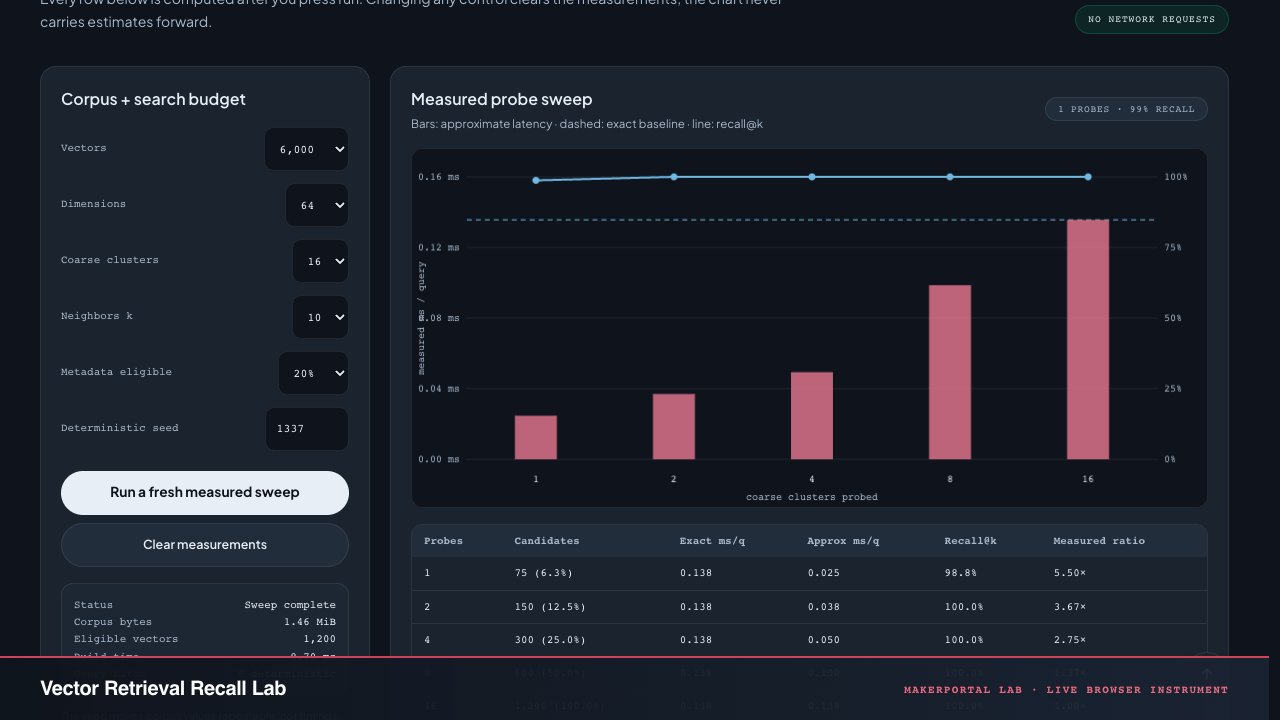
Continue the experiment
Record → retrieve → generate → verify → iterate
Exact on-device footprint math, no throughput guesswork
Your GPU vs a cloud GPU, measured — never estimated