Field note / On-Device AI
ANEForge hits 2.28× speculative decode
ANEForge reaches 16.8 tok/s on Qwen3-8B (up from 7.4), hitting the verify(K)≈verify(1) ceiling at 29.6 GB/s vs Orion's 42.8 GB/s floor.

Joshua HriskoPrincipal Engineer
7 min readSan Francisco, CA
Composed from the signals scanned on 2026-08-10.
ANEForge’s 2.28× speculative-decode speedup (7.4 → 16.8 tok/s on Qwen3-8B) is the ceiling the verify(K) ≈ verify(1) condition allows. Nothing is left to recover on the verification side. Work backward from those figures under int4-LUT compression and the baseline implies 29.6 GB/s effective ANE bandwidth — below the 42.8 GB/s our published Orion measurement implies for GPT-2 124M on a split ANE+CPU path, consistent with an 8B model streaming from unified DRAM rather than on-chip SRAM.
What ANEForge claims
ANEForge states it compiles tensor graphs directly into ANE programs through the private aned stack, bypassing CoreML entirely. The claims below are reported by ANEForge; the studio has not independently verified them.
| Claim | Figure | Conditions |
|---|---|---|
| ResNet-18 inference | 0.33 ms | Pretrained, cosine 1.0000 vs. reference, pure ANE |
| MLPerf ResNet-50 accuracy | fp16 76.44% (= fp32) | submission_checker v5.1, all 3 edge scenarios VALID |
| Speculative decode | 2.28× (7.4 → 16.8 tok/s) | Qwen3-8B + 0.6B draft, exact speculation |
| Retrieval embedding | 4–5× faster than GPU | cosine 1.0000, LangChain Embeddings drop-in |
| Energy efficiency | 8–16× better than GPU | All three measured workloads; GPU leads ViT-B/16 in latency |
| Stable Diffusion 1.5 | U-Net 1.5%, VAE 4.4% rel. error | Per-component vs. reference |
| Fluid simulation energy | ~9 J total | 1.48 W measured rail |
| Dispatch floor | ~70 µs | Program reused across calls |
| int4-LUT compression | ~4× smaller | vs. fp16; dequant on-engine |
| Cross-compilation | 28 ANE targets (M1–M5) | Latency estimation included; no target hardware required |
ANEForge also states that af.sdpa exposes the fused-attention layer Apple’s compiler decomposes and never emits, and that 18 additional native layers (argmax, topk, sort, geometry) are accessible that CoreML cannot reach.
Bandwidth-bound decode and the Orion denominator
Autoregressive decode is bounded by how fast model weights stream from memory per generated token. The governing relationship is:
where is effective memory bandwidth in bytes per second and is model size in bytes. Our Orion field note measured 172.4 tok/s for GPT-2 124M fp16 with transformer blocks on ANE and wte + logits on CPU. That model occupies , so:
Because wte and logits ran on CPU in that measurement, the ANE-only path exceeded this — 42.8 GB/s is a conservative floor.
ANEForge reports Qwen3-8B at 7.4 tok/s baseline. ANEForge’s int4-LUT claim puts the compressed model at . Substituting:
With speculative decode at 16.8 tok/s under the same int4 assumption:
| Model | Format | tok/s | Implied | Path | Source | |
|---|---|---|---|---|---|---|
| GPT-2 124M | fp16 | 0.248 GB | 172.4 | 42.8 GB/s | ANE + CPU (split) | Our Orion measurement |
| Qwen3-8B | int4 (derived from claim) | 4 GB | 7.4 (base) | 29.6 GB/s | ANE | ANEForge reports |
| Qwen3-8B | int4 (derived from claim) | 4 GB | 16.8 (spec) | 67.2 GB/s | ANE | ANEForge reports |
The baseline Qwen3-8B decode (29.6 GB/s) sits below Orion’s conservative floor (42.8 GB/s). GPT-2 124M at 248 MB fits in ANE on-chip SRAM; Qwen3-8B at 4 GB (int4) does not, so every token incurs DRAM latency — which explains the bandwidth shortfall despite comparable hardware. The speculative case (67.2 GB/s) exceeds the Orion floor, suggesting verification’s batch structure loads the memory bus more efficiently than single-token decode even when weights reside in DRAM.
Speculative decode ceiling
When verify(K) ≈ verify(1), the per-round cost is dominated by one target model pass regardless of how many draft tokens are being verified. The speedup formula collapses to:
where is the expected accepted draft tokens per round. Substituting ANEForge’s figures:
That figure is both the measured speedup and the theoretical ceiling under the stated condition. Exceeding it without changing verify behavior requires either a higher-quality draft model (raising ) or a faster target decode (raising the 7.4 tok/s base). ANEForge has extracted everything the verification path can offer.
On GPU, verify(K) typically grows with K once the batch becomes compute-bound, forcing a tradeoff between draft length and verification cost. ANE sidesteps this. Autoregressive decode on ANE is memory-bandwidth-bound rather than compute-bound — the same property that set the bandwidth floor above — so verify(K) ≈ verify(1) holds. ANEForge’s claim that “decode is latency-bound” is the mechanistic explanation for why the simplified speedup formula applies here and not on GPU.
Dispatch floor and audio buffer compatibility
ANEForge reports a ~70 µs dispatch floor for reused programs. At 48 kHz with a 256-sample buffer, the available window per block is:
The dispatch overhead consumes of that budget. At 128 samples (2.67 ms) it rises to 2.6%. Adding ResNet-18 at ANEForge’s reported 0.33 ms brings total ANE overhead to , or 7.5% of a 5.33 ms window — a workable margin before remaining DSP budget is allocated.
Compile amortization is a separate cost. ANEForge states programs compile once and reuse, but publishes no compile times. Our Orion note measured ~4,200 ms full compile for Stories110M — the closest published proxy. If ANEForge’s times are in that range, break-even at the dispatch floor requires:
At 187.5 dispatches per second (256-sample / 48 kHz), that is 320 seconds of sustained runtime. First-launch compile latency matters for a live session. For offline batch neural DSP, it’s a rounding error.
What cannot be concluded
ANEForge does not state the weight format for the Qwen3-8B benchmark. The bandwidth analysis treats the int4-LUT compression claim as the operative assumption; if the benchmark ran at a different quantization level, all three figures shift proportionally. At fp16, the baseline would imply — hard to reconcile with Orion’s 42.8 GB/s floor without a separate explanation. The compile amortization calculation borrows Orion’s figure for a different model and graph structure; it establishes a directional bound, not a precise prediction for ANEForge’s 58-fused-operator compilation path.
What this means for Biquadia
The 70 µs dispatch floor puts ANE-backed neural DSP inside real-time audio budgets at 256-sample / 48 kHz — under 8% overhead for a ResNet-18-scale model. For Biquadia’s always-on neural enhancement path, the 8–16× energy advantage ANEForge reports over GPU is directly relevant: at the 1.48 W rail ANEForge measured for its fluid simulation, sustained inference is thermally viable on passively cooled M-series silicon. GPU use is not.
The 18 native layers unreachable through CoreML — including argmax, topk, and sort — and the fused-attention path matter for any Biquadia model component that currently falls back to CPU because CoreML decomposes or rejects the op. Cross-compilation support across all 28 targets (M1–M5) reduces per-device test matrices without requiring every chip generation in-house. For latency budget context on the ANE audio path, see our presspeech note; for ANE compile overhead precedent, see our Orion decode analysis.
Method: this note was drafted by us.anthropic.claude-sonnet-4-6 from two sources — the published README of sbryngelson/ANEForge and this studio’s own published measurements, linked above. Before publication an automated gate re-checked every extracted claim against the source document (18 claim(s) and 0 quantity(ies) verified) and every claim-shaped number in the draft against that evidence (21 derived from it, 19 row(s) supplied from our own tables). The studio has not re-run sbryngelson/ANEForge’s benchmarks; figures attributed to it are its own.
FAQ
Is the private API dependency a shipping risk?
ANEForge states it operates from an ordinary user process with no entitlements and without disabling SIP. The aned stack it calls is also used by CoreML, MPSGraph, and Espresso — Apple has strong incentive not to break it silently. That said, Apple has changed private ANE interfaces across OS point releases before, and ANEForge makes no ABI stability claim. Any Biquadia integration path would need a functioning CoreML or CPU fallback.
Does passing the MLPerf submission_checker mean this is production-grade inference?
ANEForge reports passing MLCommons submission_checker v5.1 for all three edge scenarios with fp16 accuracy equal to fp32 (76.44%). The checker validates output accuracy against a reference implementation. It does not cover sustained-load throughput, thermal throttling, or multi-session isolation. The VALID result is a meaningful accuracy bar, not a substitute for a long-duration inference profile under real workload conditions.
Why is the Qwen3-8B baseline (7.4 tok/s) so much slower than Orion's GPT-2 result (172.4 tok/s)?
The models differ by roughly 64× in parameter count. The bandwidth analysis shows the 8B baseline implies only 29.6 GB/s effective bandwidth versus 42.8 GB/s for GPT-2 124M. GPT-2 124M at 248 MB sits in on-chip memory; Qwen3-8B at 4 GB (int4) does not, and the bandwidth shortfall reflects that — DRAM access latency on every token.
What compile overhead should I budget when adopting ANEForge?
ANEForge does not publish per-model compile times — only the ~70 µs per-call dispatch floor for reused programs. Our Orion note measured ~4,200 ms full compile for Stories110M, the closest available proxy for ANE program compilation at similar scale. At 187.5 dispatches per second under a 256-sample / 48 kHz audio workload, amortizing a 4,200 ms compile to under 1% of per-call cost requires roughly 320 seconds of operation — meaningful for first-launch user experience, negligible for offline batch pipelines.
Recommended Studio & Hardware Gear
Affiliate links support independent R&DTested studio equipment and reference hardware utilized for this build. Product images & pricing sourced from Amazon Creators API / SparkFun Electronics.
 $29.10Book
Real-Time Systems
Schedulability Theory: hyperbolic bound, SRP, and response-time analysis R_i = C_i + Σ⌈R_i/T_j⌉ C_j — formulas this scheduler evaluates to predict deadline misses before Gantt draws them.
 $6,999.00Computer
Apple MacBook Pro M5 Max, 128GB Unified Memory, 2TB SSD
The portable 128 GB machine. Same resident-model argument as the Mac Studio, in a laptop you can profile on.
 $329.00Wearable
Apple Watch Series 11, GPS 46mm, Jet Black Aluminum
The watchOS target itself. Any on-device inference claim for the Watch is bounded by its CPU-accessible bandwidth, which Apple does not publish.
 $1,699.00Computer
Apple MacBook Air 13-inch M5, 32GB Unified Memory, 512GB SSD, Midnight
32 GB of unified memory in the lightest Apple silicon body — enough to keep a quantized mid-size model resident instead of streaming it off SSD.
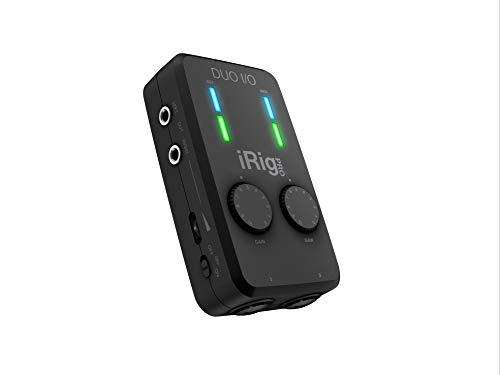 $229.99Audio interface
IK Multimedia iRig Pro Duo I/O USB audio interface, TRS balanced & headphones outputs, audio mixer to 24-bit, midi interface for music studio, recording, podcasting, streaming & social apps
Portable 2-channel USB-C audio interface used for mobile Biquadia field recording.
Prices shown were retrieved from the Amazon Product Advertising API on 19 July 2026 and are indicative only — the price and availability on Amazon at the time of purchase apply.
Prices shown were checked against the Amazon product listing on 9 August 2026 and are indicative only — the price and availability on Amazon at the time of purchase apply.