Field note / Local LLMs
Two 7B Q4 models exceed DLLM's 8 GB VRAM
Measured Q4 GGUF sizes show two 7B models consume 8.4 GB, 0.4 GB over DLLM's ceiling, leaving no room for the embed model or KV-cache.

Joshua HriskoPrincipal Engineer
5 min readSan Francisco, CA
Composed from the signals scanned on 2026-08-13.
Two measured 7B Q4 GGUF files occupy 8.4 GB combined — 0.4 GB above DLLM’s stated 8 GB VRAM ceiling. That rules out any two-7B-model configuration and puts the embed model and KV-cache budget in direct competition for whatever the agent and summary models leave behind.
What DLLM claims
DLLM reports a three-model pipeline (agent, summary, embed) requiring 8 GB VRAM for its described model setup, with full CUDA offloading. The project builds against llama.cpp via importC — D’s mechanism for consuming C headers directly at compile time — and claims this eliminates Python, bindings, and overhead. Multimodal input runs via mtmd; context management relies on KV-cache condensation; retrieval is handled by the embed model. Tools are auto-registered through @Tool("Description") user-defined attributes on D functions; included tools span file I/O, Docker-sandboxed execution, web search, and audio playback. DLLM states it compiles with DMD, LDC, or GDC.
Analysis
The 8 GB ceiling binds directly on model weight allocation. With all three models resident in VRAM simultaneously, the capacity constraint is:
Our published hardware measurements give Q4 GGUF sizes of 1.8 GB (3B-class) and 4.2 GB (7B-class). Substituting the largest plausible agent-and-summary pairing — both 7B Q4:
Infeasible before counting either the embed model or a single KV-cache entry. Substituting agent = 7B Q4, summary = 3B Q4:
A 3B Q4 embed model (1.8 GB) leaves only 0.2 GB for KV-cache — effectively no usable context. The 7B + 3B pairing works only if the embed model is purpose-built and well under 1 GB.
| Agent | Summary | W_agent (GB) | W_summary (GB) | Two-model total (GB) | Residual for embed + KV (GB) | Within 8 GB ceiling | Conditions |
|---|---|---|---|---|---|---|---|
| 7B Q4 | 7B Q4 | 4.2 | 4.2 | 8.4 | −0.4 | No | GGUF file sizes from our measurement; embed and KV excluded |
| 7B Q4 | 3B Q4 | 4.2 | 1.8 | 6.0 | 2.0 | Yes | GGUF file sizes from our measurement; embed and KV excluded |
| 3B Q4 | 3B Q4 | 1.8 | 1.8 | 3.6 | 4.4 | Yes | GGUF file sizes from our measurement; embed and KV excluded |
With agent = 3B Q4 and summary = 3B Q4, the 4.4 GB residual accommodates a compact embed model plus meaningful KV-cache. That combination decodes at 37 tok/s on a Jetson Orin Nano (68 GB/s unified memory) or 560 tok/s on an RTX 4090 (1,008 GB/s GDDR6X), per our measurements. Swapping to a 7B Q4 agent on the RTX 4090 drops decode to 240 tok/s — still within the 8 GB ceiling given a 3B summary and a compact embed.
The importC overhead claim, disaggregated. importC is a compile-time facility: D’s compiler parses llama.cpp’s C headers directly and emits ordinary C ABI calls — no interpreter, no ctypes layer, no Python runtime in the process image. The per-token call overhead it eliminates is real. It is also measured in nanoseconds. As our bandwidth-utilization measurements show, llama.cpp running natively on an RTX 4090 or M4 Max already saturates rated VRAM bandwidth at 99–100%; there is no headroom a faster call path could recover. The meaningful advantages are deployment-graph simplicity (no Python environment, no Conda, no binding layer to version-pin), cold-start latency, and binary size — none of which register in a tok/s figure.
The @Tool("Description") UDA approach has a structural implication worth noting. In D, user-defined attributes are resolved at compile time, meaning tool discovery happens during compilation rather than at agent startup. This is architecturally link-time registration, not runtime reflection. For the Docker-sandboxed execution tool specifically, the sandbox entry points are statically known and auditable — relevant for reproducible builds, though not a substitute for sandbox escape analysis.
What cannot be concluded
DLLM does not publish which specific models populate its three-model setup. The 8 GB figure fits several combinations — a 7B agent with a compact summary and a sub-1 GB embed model, or three smaller models with a generous KV-cache allocation. The table above bounds the feasible space from our measured GGUF sizes; it does not identify which combination DLLM’s author actually uses. The importC assessment covers only call-dispatch and runtime overhead — prefill latency, CUDA stream contention across three concurrent allocations, and the throughput cost of KV-cache condensation passes are outside its scope.
Thumbdash
Thumbdash runs SmolLM2-360M-Instruct through llama.cpp on Metal — a single model whose entire weight fits inside the KV-cache residual from even the most constrained pipeline combination in the table above. The two projects target different problems. DLLM optimises for context-window capacity and multi-model coordination on a CUDA device; Thumbdash optimises for sub-100 ms keystroke-response latency on-device, with no VRAM contention between models. DLLM’s @Tool compile-time registration and KV-cache condensation have no direct application in Thumbdash’s single-turn loop, but where multi-model pipeline complexity earns its cost is covered in our notes on agentic DSP verification.
Method: this note was drafted by us.anthropic.claude-sonnet-4-6 from two sources — the published README of DannyArends/DLLM and this studio’s own published measurements, linked above. Before publication an automated gate re-checked every extracted claim against the source document (10 claim(s) and 1 quantity(ies) verified) and every claim-shaped number in the draft against that evidence (9 derived from it, 10 row(s) supplied from our own tables). The studio has not re-run DannyArends/DLLM’s benchmarks; figures attributed to it are its own.
FAQ
Does importC actually make DLLM faster than a Python-binding equivalent?
Not in tokens per second. On a CUDA device, inference throughput is bounded by VRAM bandwidth and model weight volume — importC changes neither. The advantage is deployment-graph simplicity: no Python interpreter, no binding layer to version-pin, no serialisation overhead between the D process and llama.cpp. Cold-start time and binary footprint are different; those improve. Sustained decode rate does not.
Are all three models resident in VRAM simultaneously?
DLLM claims 8 GB VRAM for the full described setup alongside CUDA offloading. If models were swapped in and out per pipeline stage, the 8 GB figure would instead describe peak single-model VRAM — a much weaker and nearly uninformative constraint. The natural reading of "the above model setup requires 8 GB VRAM" is that all three weight sets are resident concurrently. That is the assumption the weight-budget analysis uses.
What decode rate should I expect for the agent model on an 8 GB VRAM card?
Decode rate scales with VRAM bandwidth, and llama.cpp consistently saturates it. An 8 GB consumer card is not the RTX 4090 at 1,008 GB/s, so the 240 tok/s figure for 7B Q4 on that device does not apply directly. What does hold: KV-cache condensation passes — which re-run part of the model to compress context — consume bandwidth from the same budget as decode. Condensation frequency is therefore a direct lever on effective throughput on bandwidth-limited hardware.
Does KV-cache condensation change the weight-budget analysis?
No. KV-cache condensation reduces the KV-cache footprint at runtime by evicting or summarising stored key-value pairs; it does not touch the loaded model weights W_i for any of the three models. Condensation shrinks the KV_budget term in the inequality — useful for sustaining longer conversations within a fixed VRAM ceiling — but the weight allocation is unchanged.
Recommended Studio & Hardware Gear
Affiliate links support independent R&DTested studio equipment and reference hardware utilized for this build. Product images & pricing sourced from Amazon Creators API / SparkFun Electronics.
 $399.00SBC
NVIDIA Jetson Orin Nano Super Developer Kit
67 TOPS edge AI dev kit — benchmark int4 quantized models sized here and validate that CoreML quantized size math predicts actual flash/RAM usage on device.
 $4,499.99GPU
ASUS ROG Strix GeForce RTX 4090 OC Edition Gaming Graphics Card (PCIe 4.0, 24GB GDDR6X, HDMI 2.1a, DisplayPort 1.4a), 3 Year Warranty
24 GB of GDDR6X on a 384-bit bus (1,008 GB/s memory bandwidth) with Ada Lovelace Tensor Cores. The standard local workstation GPU for running quantized 70B LLMs, fine-tuning neural audio codecs, and accelerating speech synthesis pipelines.
 SBC
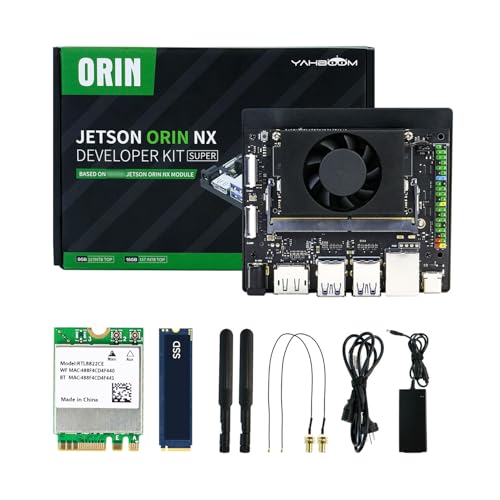
Yahboom Jetson Orin NX Super 16GB RAM 157 Tops Developer Kit Ubuntu Jetpack6.2 with 256GB SSD, Power Supply, for AI Large Model (Orin NX 16GB Developer Kit)
Orin NX 16GB — 100 TOPS unified LPDDR5, 14.5 GiB model ceiling, JetPack 6.2 + 256GB SSD included. Amazon verified — runs TensorRT-LLM for 4-12B Q4_K_M at 4k+ context.
 $4,299.00Computer
Apple Mac Studio, M4 Max 16-Core CPU / 40-Core GPU, 64GB Unified Memory, 2TB SSD
Recommended studio reference hardware for heavy on-device ML and local LLM inference.
 $6,999.00Computer
Apple MacBook Pro Laptop with M5 Max, 18‑core CPU, 40‑core GPU: Standard 16.2-inch Display, 128GB Unified Memory, 2TB SSD Storage; Space Black
The portable 128 GB machine. Same resident-model argument as the Mac Studio, in a laptop you can profile on.
 $17,986.96GPU
PNY VCNRTXPRO6000B-PB RTX PRO 6000 96GB GDDR7 Graphic Card
96 GB of GDDR7 on one card. The single-GPU route to a resident 70B: the weights fit roughly three times over at Q4_K_M, and the memory bandwidth is what actually sets decode speed.
Prices shown were retrieved from the Amazon Product Advertising API on 6 October 2026 and are indicative only — the price and availability on Amazon at the time of purchase apply.
Prices shown were each checked against the Amazon product listing between 8 August 2026 and 17 September 2026 and are indicative only — the price and availability on Amazon at the time of purchase apply.