Playground · research instrument
DSP · AudioRoom Shape Optimizer
Every room calculator asks for dimensions and hands back a mode list. This one runs the other way: give it the volume you already have, and it searches the shapes for the one whose axial modes are spread most evenly — then shows you the whole design surface it searched, cliffs and local minima included, so you can see how sharp the answer really is.
Independent research instrument — not claimed as MakerPortal shipped product code. Methods, equations, assumptions, and limitations are disclosed so you can inspect what the page does and does not establish.
Solve for the shape
The objective is the worst axial gap: sort every axial mode below 200 Hz and take the widest space between neighbours. Small is good — a wide gap is heard as a hole in the bass, not as neutrality. Volume is held exactly; only the two shape ratios and are free, and both are confined to the Bolt area.
The space you have
Roughly a 15 × 20 ft room with an 8 ft ceiling at 2,400 ft³.
Solved shape
—
—
—
—
—
The shape it is not allowed to pick
—
The design surface it searched
dark = smaller worst gap = better
Horizontal axis from 1.1 to 3.2, vertical axis from 1.0 to 1.9. The greyed region is outside the Bolt area. Small circles are the grid seeds the search refines from — it uses several because this surface has hundreds of local minima and one descent is not enough. The line is the winning refinement, and the gold ring is the answer. That line is short on purpose: the coarse grid already lands close, and the refinement only has a cell or two left to walk.
Axial modes of the solved room
vs a cube of the same volume
A cube is the worst case and the reason the comparison is here: all three axes share one series, so its axial modes triple up and leave everything between them empty.
Method, and why it is shaped this way
The objective
Axial modes are per axis. Pool all three series, keep everything at or below 200 Hz, sort, and take the largest difference between neighbours. The tool minimises that number.
The constraints
Volume exactly as entered, and the ratios inside Bolt's published area. Both are load-bearing: drop either and the answer degenerates into "build something bigger" or "build a corridor" at every input.
The search
A coarse feasible grid seeds a compass search that only ever compares values and never differences them, so the jump discontinuities cost it nothing. Two variables, a couple of thousand evaluations, a few milliseconds.
The forward model is shared, not reimplemented: the solver scores candidates with the same closed form thatthe room mode analyzerand the published room pages use, and the figure it reports for the winning room is recomputed through that function before it is shown.
Limits & questions
Why does it ask for the volume instead of solving for the best room outright?
Because "the best room outright" has a trivial answer. With volume free the objective is monotone in volume — a bigger room has lower, denser modes and therefore smaller gaps — so an unconstrained solver returns the largest room in its search range at every scale, with a confident face. Volume is the thing you actually have; shape is the thing you can choose.
Why is the answer restricted to the Bolt area?
Because fixing the volume is still not enough. At a fixed 2,400 ft³ the objective is monotone in elongation: widen the allowed ratios and the optimum runs to the boundary every time, from 8 × 30 × 10 ft down to 1.57 × 174.7 × 8.74 ft — a corridor. A 6.65 × 38 × 9.5 ft corridor genuinely scores 14.81 Hz against this tool's 19.14 Hz answer at the same volume. Something has to exclude it, and that something should be a published criterion rather than a search range someone typed into a script. Bolt (1946, JASA) is the criterion this site already reports on every room-mode page.
What does "the Bolt limit is active" mean when it appears?
It means the search stopped at the edge of the Bolt area rather than at an interior optimum — the elongation pull above has pushed the answer into the boundary and the criterion is what held it. Below about 3,000 ft³ the answer is genuinely interior. Above it, the reported shape is the most elongated one Bolt permits, and you should read it as "Bolt's limit for this volume", not as a free optimum.
Why does the landscape look so lumpy?
Because it is. On a 381 × 381 grid at fixed volume the objective has 291 strict local minima, and it has genuine jump discontinuities: the figure is the widest gap among axial modes below 200 Hz, so when a mode carrying that gap crosses 200 Hz and leaves the window, the objective drops in one step. At an L/H of 1.27744 that step is 6.33 Hz, and sampling 80× finer leaves it at 6.33 Hz rather than shrinking it. That is why this tool uses a derivative-free pattern search: gradient descent from random starts finds the optimum only 38% of the time here.
Is the worst axial gap the only thing that matters?
No. It is one figure, chosen because it is well defined and because a wide hole between adjacent axial modes is audible as a hole. It says nothing about tangential and oblique modes, absorption, speaker and listener placement, or construction. Treat the answer as a starting proportion, not a specification.
Why do two different rooms sometimes get the same score?
Axial modes are n·c/2L taken per axis, so the axial spectrum is a symmetric function of the three dimensions and permuting them changes nothing — 8 × 13.75 × 11 ft and 11 × 13.75 × 8 ft score identically to the last digit. Bolt requires height ≤ width < length, which admits exactly one of the six orderings, so this tool never has to break that tie arbitrarily.
What model is behind it?
A rigid-walled rectangular box with c = 343 m/s at 20 °C, the same closed form used by the room-mode analyzer and by the 653 published room pages — the solver calls that exact function, it does not re-derive it. Real rooms have doors, soffits, non-rigid walls and absorption; none of that is modelled here.
Shareable still
The instrument, captured—not illustrated.
This 16:9 frame is rendered from the real browser instrument above. It is the page's canonical preview for image search, link unfurls, and posts that need to show what the tool actually does.
Download 1280 × 720 JPEG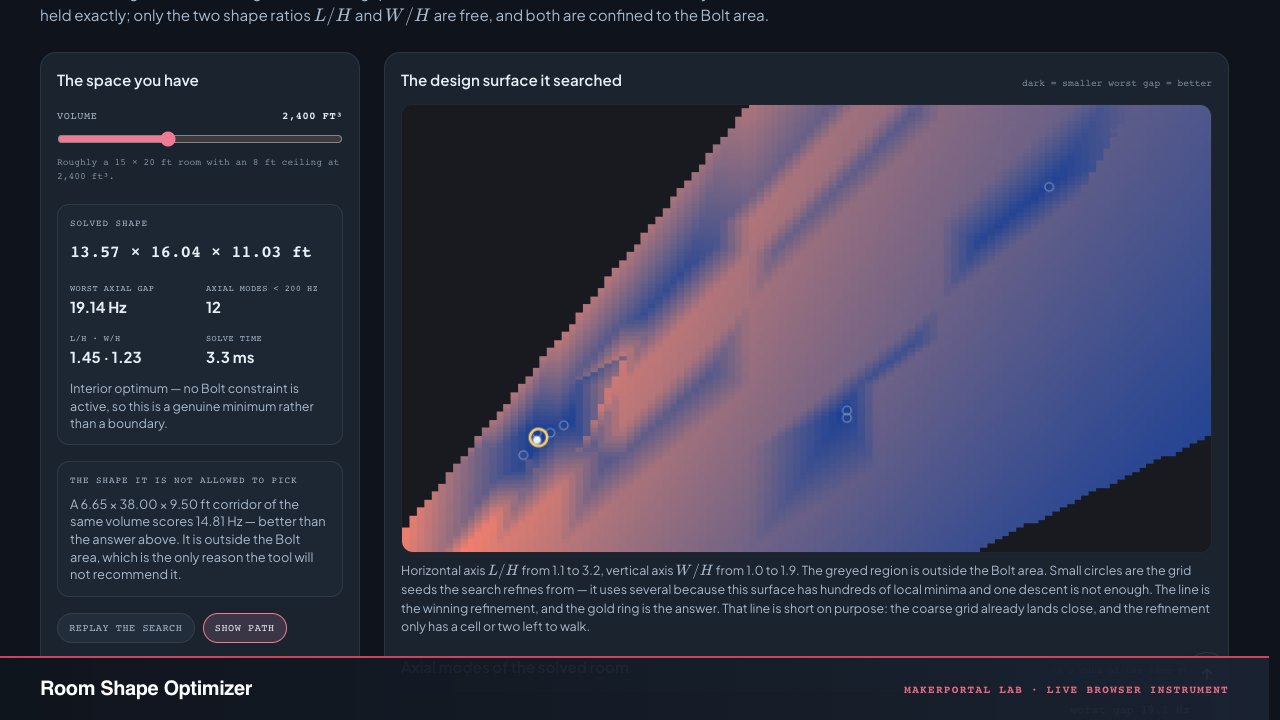
Continue the experiment