01 · Waist to Rayleigh range
At the waist, the complex beam parameter is purely imaginary: .
Playground · research instrument
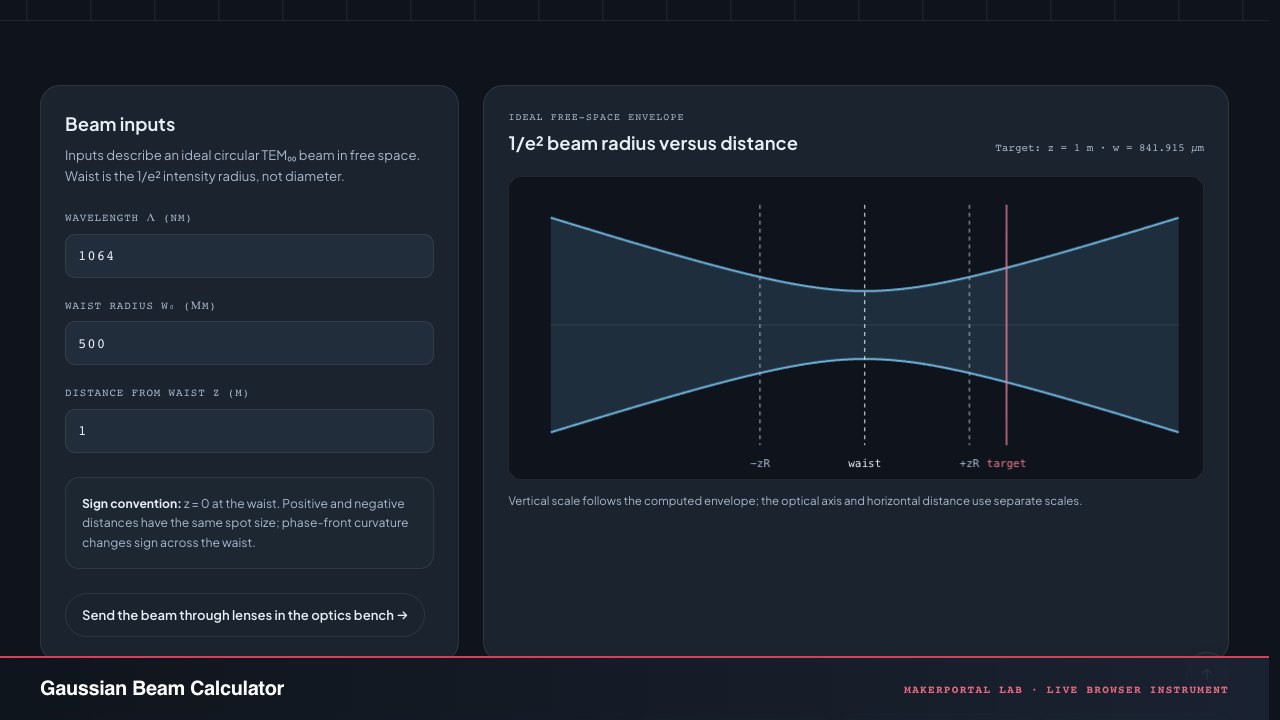
Enter wavelength, waist radius and distance. The calculator propagates the complex q parameter to give the ideal 1/e² beam size, Rayleigh range, divergence and phase-front curvature — with the full beam envelope drawn to scale.
Independent research instrument — not claimed as MakerPortal shipped product code. Methods, equations, assumptions, and limitations are disclosed so you can inspect what the page does and does not establish.
Inputs describe an ideal circular TEM₀₀ beam in free space. Waist is the 1/e² intensity radius, not diameter.
Ideal free-space envelope
Target: z = 1.00 m
Vertical scale follows the computed envelope; the optical axis and horizontal distance use separate scales.
Calculated beam
q(z) = 1.000000 + 0.738156i m
01 · Waist to Rayleigh range
At the waist, the complex beam parameter is purely imaginary: .
02 · ABCD propagation
Free space over z uses , so the solver applies the same q propagation used by the full optics bench.
03 · Radius from q
The real part gives phase-front curvature R; the imaginary part gives the 1/e² intensity radius w.
Both are solved when the page is built, by the same q-propagation the calculator runs, and checked against the closed-form textbook results in the site's test suite. The same function answers /api/v1/gaussian-beam, so either example can be embedded in your own page or called as JSON.
A · How far a HeNe beam stays collimated
λ = 632.8 nm, waist radius w₀ = 0.5 mm.
Ten metres is about 8.1 Rayleigh ranges, so the beam is deep in its far field and growing almost linearly with distance.
B · Focusing a 1064 nm beam with a lens
Collimated input radius W = 2 mm, thin lens f = 100 mm.
The waist sits 0.0072 mm inside the geometric focus: a Gaussian beam focuses slightly short of f, by an amount that grows as f approaches the input beam's own Rayleigh range.
For a collimated beam of 1/e² radius W focused by a lens of focal length f, the new waist is w₀′ = W·(f/z_R)/√(1+(f/z_R)²), with z_R = πW²/λ of the incoming beam, which is very close to λf/(πW) whenever f is much shorter than z_R. Worked example: a 1064 nm beam of 2 mm radius through a 100 mm lens focuses to w₀′ = 16.93 µm, 99.9928 mm behind the lens, with a Rayleigh range of 0.847 mm.
The Rayleigh range z_R = πw₀²/λ is the distance from the waist at which the beam's area has doubled; within ±z_R the beam is close to collimated. Worked example: a 632.8 nm HeNe beam with a 0.5 mm waist radius has z_R = 1.241 m, diverges at 0.403 mrad, and has grown to 4.06 mm radius 10 m away.
The waist w₀ is a radius: the distance from the optical axis where an ideal Gaussian beam’s intensity falls to 1/e² of its on-axis value. The calculator reports both radius and diameter to make that convention explicit.
At z = zR, the beam radius is √2 times the waist radius, the cross-sectional area has doubled, and the phase-front radius of curvature is 2zR.
No. It solves an ideal TEM₀₀ beam with M² = 1 in free space. A measured beam with M² greater than one expands faster, while clipping, astigmatism, chromatic dispersion and lens aberrations require a richer model.
Shareable still
This 16:9 frame is rendered from the real browser instrument above. It is the page's canonical preview for image search, link unfurls, and posts that need to show what the tool actually does.
Download 1280 × 720 JPEG