Field note / MotionLink
CMHeadphoneMotionManager: What You Really Get
Quaternion attitude from the Headphone Motion API, why the reference frame resets on every launch, and the recentering pattern that fixes it.

Joshua HriskoPrincipal Engineer
5 min readSan Francisco, CA

Apple’s own documentation for CMHeadphoneMotionManager is thin — a handful of property listings, no worked example of what to do with the data once it arrives. Most of the coverage that exists online is about AVAudioEnvironmentNode’s built-in head-tracked spatial audio, which uses this same sensor pipeline under the hood but hides it behind a higher-level API. If you want the raw motion stream — to drive a head-controlled interface, or to log orientation data for research — you’re mostly reading header comments and finding out the rest on-device. MotionLink exists because we needed the raw stream, not the abstraction.
The data comes as a quaternion, not angles
Every CMDeviceMotion update off the manager carries attitude.quaternion — an (x, y, z, w) unit quaternion describing the headphone’s orientation. That’s the right representation for the sensor to emit: quaternions don’t suffer gimbal lock and interpolate cleanly, which matters at the update rates CoreMotion runs at. But almost nothing downstream wants a quaternion directly. A head-controlled UI wants yaw to pan a view; a spatial-audio prototype wants yaw/pitch to feed a panner. So the first real piece of code in MotionLink is a quaternion→Euler conversion:
func yawPitchRoll(from q: CMQuaternion) -> (yaw: Double, pitch: Double, roll: Double) {
    let yaw = atan2(2 * (q.w * q.z + q.x * q.y), 1 - 2 * (q.y * q.y + q.z * q.z))
    let pitch = asin(max(-1, min(1, 2 * (q.w * q.y - q.z * q.x))))
    let roll = atan2(2 * (q.w * q.x + q.y * q.z), 1 - 2 * (q.x * q.x + q.y * q.y))
    return (yaw, pitch, roll)
}
The max(-1, min(1, …)) clamp on the pitch term isn’t decorative — floating-point drift can push the asin argument fractionally outside [-1, 1], and an unclamped call there returns NaN that silently propagates into every UI value downstream. That one didn’t show up in the simulator; it showed up as an occasional frozen head-tracking cursor on a real AirPods Pro after several minutes of continuous motion.
The reference frame is relative, and it resets every time
This is the gotcha that isn’t in the docs anywhere we found: CMHeadphoneMotionManager does not give you an absolute, gravity-and-magnetic-north-referenced attitude the way CMMotionManager’s device-motion API can with CMAttitudeReferenceFrame. The headphone manager gives you one reference frame, and it’s relative — whatever orientation the headphones happen to be in the moment you call startDeviceMotionUpdates, that becomes the implicit zero point. Face left, launch the app, and “forward” in your data is now pointing left.
For a research data-capture tool that’s a problem worth flagging in your own recording metadata (log the wall-clock time tracking started, since that’s your only anchor). For a head-controlled interface it’s a UX problem: users expect “center” to mean roughly where they’re currently facing, not wherever their head happened to be when the screen loaded. MotionLink’s answer is a manual recenter — capture the current attitude as a baseline offset on a UI action (a tap, not automatic), and subtract that offset from every subsequent quaternion before converting to Euler. It’s a small amount of code, but it’s not something you’d think to build until you’ve watched the “forward” direction be wrong on a real pair of headphones.
Two more things that only show up on hardware
- The simulator can’t produce this data at all.
isDeviceMotionAvailablereturnsfalsethere, full stop — every iteration of the recentering logic above had to be tested on physical AirPods Pro, not in Xcode Previews. - The update handler fires off the main thread. Like
CMMotionManager, you handstartDeviceMotionUpdatesan operation queue, and any UI mutation in that closure needs an explicitDispatchQueue.main.async— easy to forget once, and the symptom (a UI that updates but stutters or occasionally doesn’t render) doesn’t obviously point back to the thread it’s running on.
None of this is exotic. It’s the kind of friction that costs an afternoon the first time and is genuinely undocumented the first time you hit it — which is exactly the gap a field note like this is for.
MotionLink pairs specifically with AirPods Pro — the Headphone Motion API only reports data from H1/W1-chip headphones, which is why that’s the one gear pick tied to this build on /library. If you’re building anything in the ios-craft space that touches CoreMotion, the quaternion clamp above is worth stealing outright.
Want to see the math live instead of reading it? The quaternion ↔ Euler converter runs both directions with a live 3D orientation preview and copyable Swift for each.
Recommended Studio & Hardware Gear
Affiliate links support independent R&DTested studio equipment and reference hardware utilized for this build. Product images & pricing sourced from Amazon Creators API / SparkFun Electronics.
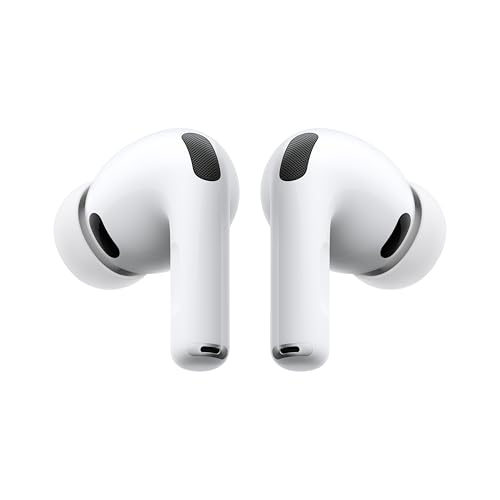 $199.99Wearable
Apple AirPods Pro 3 Wireless Earbuds, Active Noise Cancellation, Live Translation, Heart Rate Sensing, Hearing Aid Feature, Bluetooth Headphones, Spatial Audio, High-Fidelity Sound, USB-C Charging
MotionLink's head-tracking feature depends on the Headphone Motion API, which requires AirPods Pro.
 $6,999.00Computer
Apple MacBook Pro M5 Max, 128GB Unified Memory, 2TB SSD
The portable 128 GB machine. Same resident-model argument as the Mac Studio, in a laptop you can profile on.
 $1,699.00Computer
Apple MacBook Air 13-inch M5, 32GB Unified Memory, 512GB SSD, Midnight
32 GB of unified memory in the lightest Apple silicon body — enough to keep a quantized mid-size model resident instead of streaming it off SSD.
 $329.00Wearable
Apple Watch Series 11, GPS 46mm, Jet Black Aluminum
The watchOS target itself. Any on-device inference claim for the Watch is bounded by its CPU-accessible bandwidth, which Apple does not publish.
Prices shown were retrieved from the Amazon Product Advertising API on 19 July 2026 and are indicative only — the price and availability on Amazon at the time of purchase apply.
Prices shown were checked against the Amazon product listing on 9 August 2026 and are indicative only — the price and availability on Amazon at the time of purchase apply.