Playground · research instrument
On-device AIAgentic Closed-Circuit Lab
Frontier 2026: Generative UI instruments, proposed by instant heuristics and gated by a deterministic Zod → solver-registry circuit (an on-device Phi-3 may attempt first via WebGPU — private, zero-latency). The proposer sketches the experiment; Hammerstad-Jensen / RBJ / fitReport render the truth. No hallucinated numbers ever paint.
Independent research instrument — not claimed as MakerPortal shipped product code. Methods, equations, assumptions, and limitations are disclosed so you can inspect what the page does and does not establish.
Propose → Validate → Solve → Render
The stochastic half (LLM or heuristic) may only emit JSON inputs. The deterministic half — Zod + solver-registry — computes every number you see. A hallucinated Z0 = 900 Ω dies at the gate with a zod issue, never as a readout.
Heuristic proposes
JSON only
Zod gate
blocks hallucinations
Solver renders
deterministic bytes
Why this is frontier 2026
- Edge SLM: Phi-3 mini 4k via
@mlc-ai/web-llm+ WebGPU — private, no server round-trip. - Zero-round-trip tools: the MCP function definitions are snapshotted from
toolList()at build time, so the first inference fetches nothing. - GenUI: LLM → instrument JSON (Tam bo/A2UI pattern), rendered as live readouts/Smith/eye.
- Machine Experience: GenUI JSON is also an MCP endpoint — same envelope agents consume.
- Tactile Brutalism: grain-noise + 1 px borders signal human instrumentation.
Proposal gate
idleNo proposal yet — type an intent and hit Propose.
Generated instrument cluster
GenUI JSON → livev1Validated readouts appear here. No solver, no pixels — this is the “closed circuit.”
Try: “50 Ω FR4” → validated Z₀, or “75+60j” → Smith.
Raw GenUI JSON (for agents / MCP)
SSR paints the empty shell (crawlable, no JS required). The island hydrates on client:visible. Pagefind indexes the shell; agents fetch the GenUI JSON via the MCP projection.
How the circuit holds — by construction
1 · Validator is SSOT
Zod schemas in circuit-schemas.ts restate solver-registry bounds. circuitSchemaIssues() fails the audit if they drift. A proposal that passes Zod but fails registry parse (off-grid tolerance) is still rejected.
2 · Solver is reference
runClosedCircuit calls envelopeFor(registryEntry, inputs) — the same object identity the strictEqual test guards. Biquad & LLM-VRAM lanes are provably the page function.
3 · GenUI is projection
A pure map solverEnvelope → GenUI JSON chooses instruments. The Astro renderer only knows instrument kinds (readout, smith, eye) — it cannot invent a number.
// The one rule: heuristics propose inputs; an SLM may attempt; solver computes answers
import { z } from 'zod';
import { runClosedCircuit } from '../lib/circuit-engine.ts';

const raw = await llmPropose(intent); // JSON only, e.g. {W:0.3,H:0.2,Er:4.4,Zl:50}
const result = runClosedCircuit('si', raw, intent);

if (result.envelope.status === 'rejected') {
  renderHallucinationBlocked(result.envelope.issues); // never rendered as data
} else {
  // every pixel below comes from solver bytes, not LLM bytes
  renderGenUI(result.genUI); // {version:1, instruments:[{kind:'readout', value:'49.8 Ω'}]}
  showProvenance(result.envelope.solverUrl);
}
Illustrative sketch: llmPropose, renderGenUI and renderHallucinationBlocked stand in for this page’s wiring. runClosedCircuit is real.
Gear behind the instruments this circuit drives
Stack · 4 picks
Hardware picks 4
 $72.88Book
High Speed Digital Design: A Handbook of Black Magic (Prentice Hall Modern Semiconductor Design)
Defines Hammerstad-Jensen Z0, skin depth delta=sqrt(2/ωμσ), and crosstalk K_b backward coupling — closed-form behind this lab's per-unit-length L,C extraction and NEXT/FEXT formulas.
 $12.69Diagnostic
HiLetgo USB Logic Analyzer Device with EMI Ferrite Ring USB Cable 24MHz 8CH 24MHz 8 Channel UART IIC SPI Debug
Budget 8-ch USB logic analyzer (sigrok/PulseView). Useful for RTOS GPIO timing and SI digital demos — not a Saleae substitute in bandwidth.
 $85.49Diagnostic
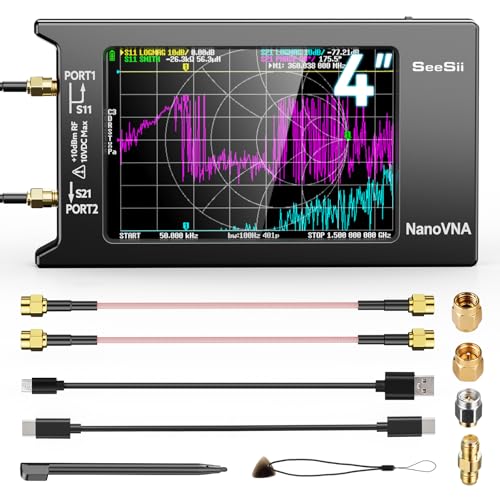
SEESII Upgraded NanoVNA-H4 Vector Network Analyzer, Latest V4.4 9KHz-1.5GHz HF VHF UHF 4" Touch Screen VNA Antenna Analyzer Measures S Parameters,Voltage Standing Wave Ratio, Phase,Delay, Smith Chart
Handheld VNA with touchscreen + SOL kit — S11/S21 lab companion for RF Bench and Antenna Sandbox.
 $13.90Kit
AURSINC SMA Calibration Kit and SMA Male to Male Jumper for NanoVNA H H4 F V2 V3 SAA Mini1300 PS100 Vector Network Analyzer Antenna Analyzer
SOL cal standards + SMA jumper for NanoVNA H/H4 — SI Lab and RF Bench SOLT demos.
Prices shown were retrieved from the Amazon Product Advertising API on 8 October 2026 and are indicative only — the price and availability on Amazon at the time of purchase apply.
Questions a principal would ask
Does the LLM ever compute a result?
No. The LLM is a proposer only. It outputs JSON inputs (e.g., {W,H,Er,Zl} for Signal Integrity). Zod validates those inputs; then the deterministic Hammerstad-Jensen / RBJ / fitReport solver computes the answer. Invalid JSON is rejected and never rendered. This is the “closed circuit”: stochastic → deterministic gate → pixels.
WebLLM vs heuristic — which proposer am I using?
Out of the box the lab is interactive with zero download via a heuristic proposer (pattern-matches intent → valid JSON). Click “Load Phi-3 mini 4k” to progressively enhance to an in-browser SLM via WebGPU (3672.07 MB of VRAM, per the runtime’s own model table — that is the VRAM it asks for, not a download size). Where a domain has a solver-registry entry (Biquad, LLM-VRAM) the model is handed that solver’s own MCP function definition, snapshotted from toolList() at build time, so the schema it sees is the schema the server enforces and the first inference costs no round-trip. web-llm allows ChatCompletionRequest.tools only on its Hermes-2-Pro / Hermes-3 ids, so with the currently pinned model every domain falls back to the strict JSON-mode prompt — the status line reports “json mode”, never “tool call”, and the panel tells you which proposer actually produced the inputs. The validator and solver are identical on every path — only the proposer changes, so audit coverage is complete without the model.
What is GenUI here?
A declarative JSON instrument cluster versioned as v1: each validated proposal is mapped to a set of instruments (readout, smith, eye, response points, markdown). The renderer has no LLM branch — it only knows how to paint those instruments from solver bytes. That is A2UI/Tambo-style Generative UI adapted to hardware.’s constraint: generated UI but deterministic numbers.
How does this extend solver-registry?
Signal Integrity and RF Bench had no registry entry (inline math in .astro <script>). This lab extracts their closed forms into src/lib/circuit-engine.ts as pure functions and gates them with zod schemas that mirror registry parseInputs bounds. Biquad and LLM-VRAM lanes delegate to solver-registry directly via envelopeFor() — same function object, provable by strictEqual.
Will this pass CI gates?
Yes. src/lib/circuit-schemas.ts:95 exposes circuitSchemaIssues() for the audit suite; Astro SSR paints the shell only (no LLM in server bundle); the island is client:visible with dynamic import() so astro check and Pagefind indexing both ignore WebLLM.
Shareable still
The instrument, captured—not illustrated.
This 16:9 frame is rendered from the real browser instrument above. It is the page's canonical preview for image search, link unfurls, and posts that need to show what the tool actually does.
Download 1280 × 720 JPEG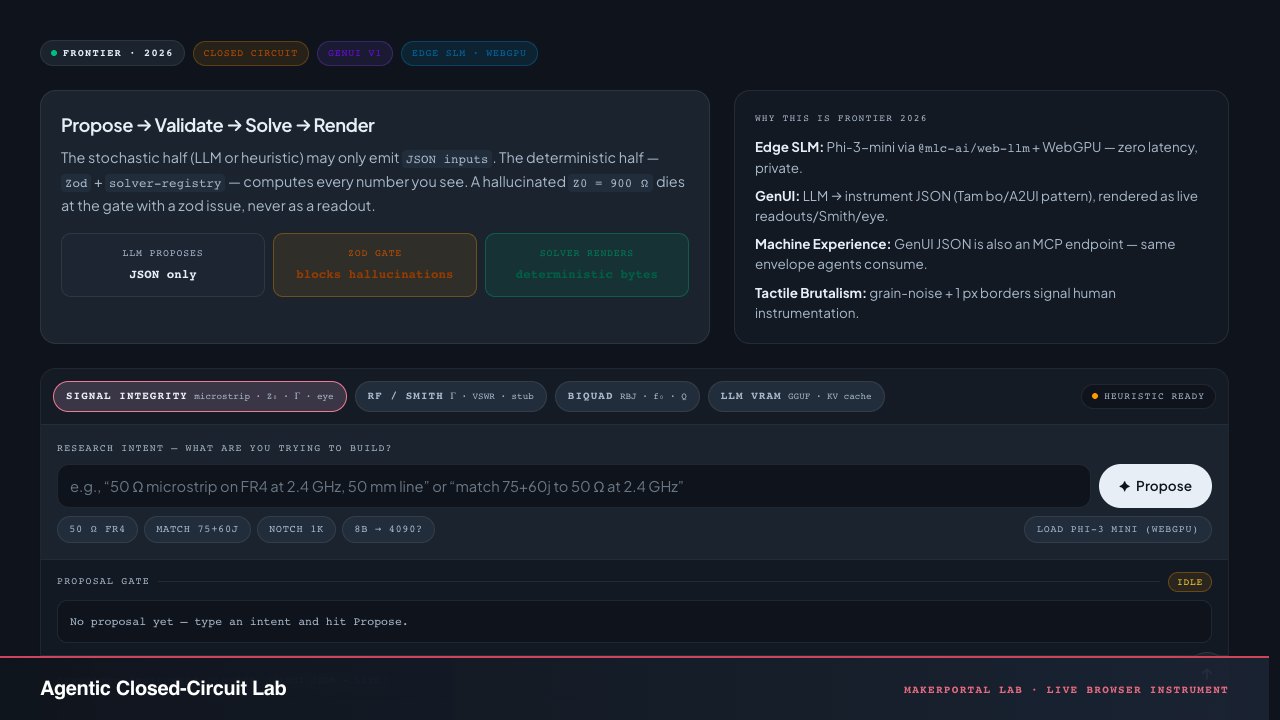
Continue the experiment